Marla here:
Of the three of us, I think I arrived in Odesa with the greatest sense of excitement. My grandmother
Dora Krafchek Waltman called Odesa, a city where she and her siblings spent a great deal of time in their youth, the Paris of the Russian Empire. She
was right.
Odesa, at least in its city centre, feels a lot like Europe. In fact, walking down some of the streets, one could be in Paris (if you ignore all of the signs in Cyrillic text). There are many European and international brand
stores lining its streets, and the architecture is a mix of 19th century apartments (many of them crumbling), restored 19th century public buildings, city
and small neighbourhood parks with outdoor cafes, late 19th/early 20th century Art Nouveau concrete buildings, and modern glass-covered shopping centres.
 |
| This arcade was finished in 1899, the same year Alfred Dreyfus is pardoned in France, and the Second Boer War started. "The More You Know!" |
 |
| You can almost hear a city official inside Odesa City Hall getting ready to draft an anti-bike bylaw |
In search of old Odesa, one only has to walk down some of its back streets. My grandmother used to talk about a common Odesan architectural element, namely the arches off main streets that lead to central courtyards and apartments. Sitting in front of the archways then, and sometimes even now, one found a 'babushka', usually an older woman acting as a concierge, gossip, and general know-it-all, guarding the gateway.
 |
| The fee for entry? (I would assume) 100 UAH or a good bowl of borscht |
Often these courtyards are now filled with cars, as well as being lined with offices or stores, but they give the residents a place to chat, play, or get some air.
 |
| Two slightly shady characters caught mid-transaction by the camera's unblinking eye |
Above the courtyards live the residents of downtown Odesa in a multitude of different types of apartments; many appear to be in very bad shape, at least externally. Even so, one gets a sense of the types of residences where my family spent time during their many visits to Odesa before and during World War One.
We visited some of the extraordinarily beautiful 19th century buildings that house some of the most important sites in Odesa. The Opera House is world famous and deservedly so; unfortunately, the only performance during our stay was the night we arrived and its production of 'Romeo and Julietta' was sold out.
 |
| What you don't see in this picture is that there are several monuments to the glorious war dead of the Soviet Union opposite the Opera House, |
Near the Opera House were other beautiful buildings, courtyards, and parks.
 |
| The aforementioned park |
 |
| So beautiful, so full of life |
 |
| If you lived in this apartment building, you'd be home by now... and forever serenaded by Ukrainian and Russian opera. |
 |
| Another unpretentious apartment block |
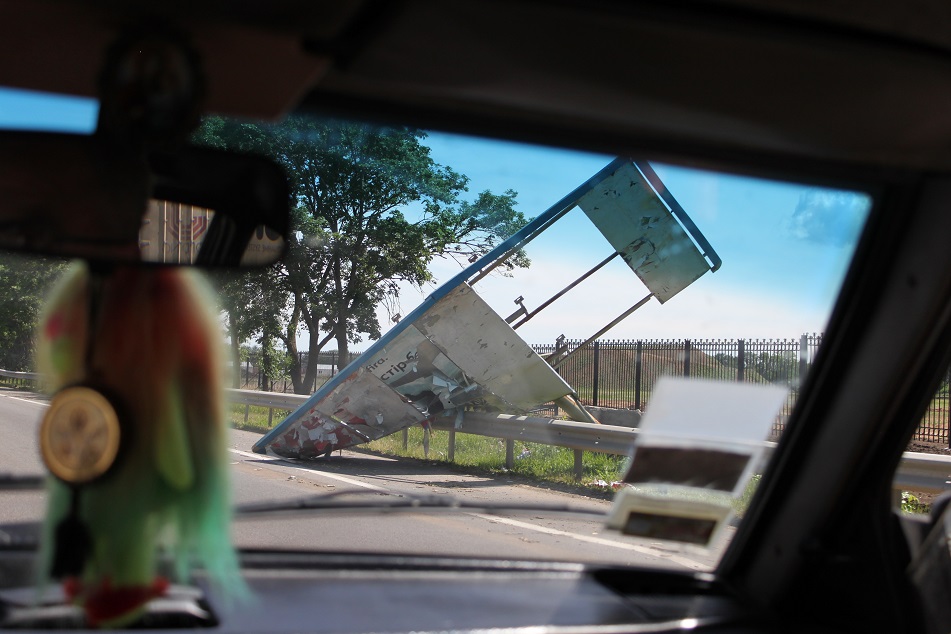
When we were in Pervomaisk, a powerful storm ripped across Ukraine. While Pervomaisk was only hit by minor damage and a short blackout, Odesa got hit much worse. We saw on the news that there was flooding and major damage. While driving into Odesa a couple days later we witnessed this damage first-hand. Large branches were torn off trees and roadside were crumpled over like pieces of paper. In the city centre, the damage was equally severe.
 |
| Going to Odesa? Good luck reading the signs. |
 |
| Don't say I didn't tell you so |
 |
| Those are branches not bushes. The canopy of the park now has huge holes in it. |
In the famous Odesa City Park, they are in the process of cutting down large old-growth trees, which, luckily, missed the bandstand when they fell. Even more fortunately, there seemed to be minimal damage to the city's historical buildings and monuments.
 |
| I'm not sure what's of greatest concern: the size of the tree that fell from the storm or the fact that child is about to be swallowed by said tree. |
While walking along the Bul Prymorsky (Prymorsky Boulevard, a tree-lined pedestrian zone above the harbour) you often hear snippets of conversations in French, German, Turkish, and English as well as Ukrainian and Russian.
 |
| Beret optional, and more accurately, highly discouraged. |
One of the places I had hoped to see when we planned our trip to Odesa
was the house of the Ephrussi family, made famous by the extraordinary
book entitled "The Hare with the Amber Eyes". However, just as we learned that our family homes in Kryzhopil and Zhabokrich no longer exist, we had a similar disappointment with the house of the Ephrussi family. Located in a prime location on the Bul Prymorsky, just opposite the Pushkin monument, we found that the house was heavily under wraps. In fact, it appears that under the wrapping, the house is in an advanced state of decay and disrepair. A real loss of what was once a beautiful house.
 |
| Wait, I think I can make out a decorative column in... no, nevermind, that's just scaffolding |
What is unlike Paris, Prague, or London, however, is that every so often, through the trees, you can see large freighters filling the waterfront.
 |
| Its products could be manufactured in China, but they could very well be shipped from Ukraine. |
While the city core is a safe haven for tourists, Odesa is also a hard-working industrial port, surrounded by factories and refineries that ship all over the Black Sea and the Mediterranean.
 |
| Smell that fabulous Black Sea air... and smoke and gasoline. |
One cannot visit Odesa without climbing the Potemkin Steps, made famous by the movie "Battleship Potemkin". As they are just around the corner from our hotel, we took the challenge, taking the steps down and then climbing back up, while trying to avoid the hustlers who wanted us to pay for photos with monkeys, hawks, and owls. (Oh my).
 |
| Also skimpy dresses and acrobats. You know, your average Monday in Odesa. | |
As well as spending our days walking through Odesa streets on our own, photographing buildings and streetscapes, we also took a private guided tour of Jewish Odesa. It was a fascinating introduction to the history of Jews in Odesa from a religious, political, historical, and artistic perspective.
We learned, for example, that six Jewish families lived in the Turkish town of Khadjibey, which became the city of Odesa in 1794. While Jews lived across Ukraine in the Pale of Settlement, Odesa was the first native city for Jews. It was an open city and contained multiple ethnic and religious groups. As the population grew, Jews felt comfortable living anywhere in Odesa as the city never contained a ghetto. Before the Revolution, 70 prayer houses and synagogues could be found in the city, with different professions, such as tailors, furniture makers, sellers of lemons, kosher butchers, etc. each developing their own shul.
 |
| The Odesa Lubavichter Synagogue was open for photographs :) |
Jews from the small settlements, such as my great-grandparents, would travel to Odesa and be thrilled and perhaps shocked by the city. I remember thinking how my relatives would have been overwhelmed with Toronto or Pittsburgh when they emigrated from Ukraine. After having learned about how cosmopolitan Odesa was in the 19th and 20th centuries, I realize now that our North American cities were pretty small potatoes compared what they experienced in Odesa!
 |
| Just a bit different from the streets in the shtetl, don't you think? |
 |
| A nice unpretentious house in Odesa |
Among other things, our tour showed us active synagogues, the Jewish Hospital (where my grandmother Dora and some of her siblings stayed when they suffered from cholera during the Revolution) and the locations of homes of well-known writers and political organizers such as Shalom Aleichem, Lev Jabotinsky, Mendele Sforim, Chaim Bialik, and Issak Babel. Odesa was a magnet for Ukrainian Jews and, in the words of Issak Babel, the city was a 'beckoning star'.
 |
| The plaque at the house where Simon Dubnov once lived. Afterwards, he moved to Lithuania, which proved to be a poor decision. |
 |
| The house of some guy named Sholom Aleichem. The text in the upper plaque is actually Yiddish not Hebrew. |
In fact, at one point over one-third of Odesa's population was Jewish, numbering about 300,000. That would change of course, after pogroms, emigration, World War Two, Stalin, Communism, and then the final emigration of Jews to Israel and other parts of the world after the fall of the Soviet Union. The city's Jewish population now sits at about 40,000.
 |
| One of the monuments commemorating the Shoah and Holocaust in Odesa. |
There is much more to say about Odesa, both from what we learned through the tour, and our own exploration, but stop we must. Let's just say that our introduction to Odesa was just that. I'll have to return to Odesa in order to learn more of its secrets.